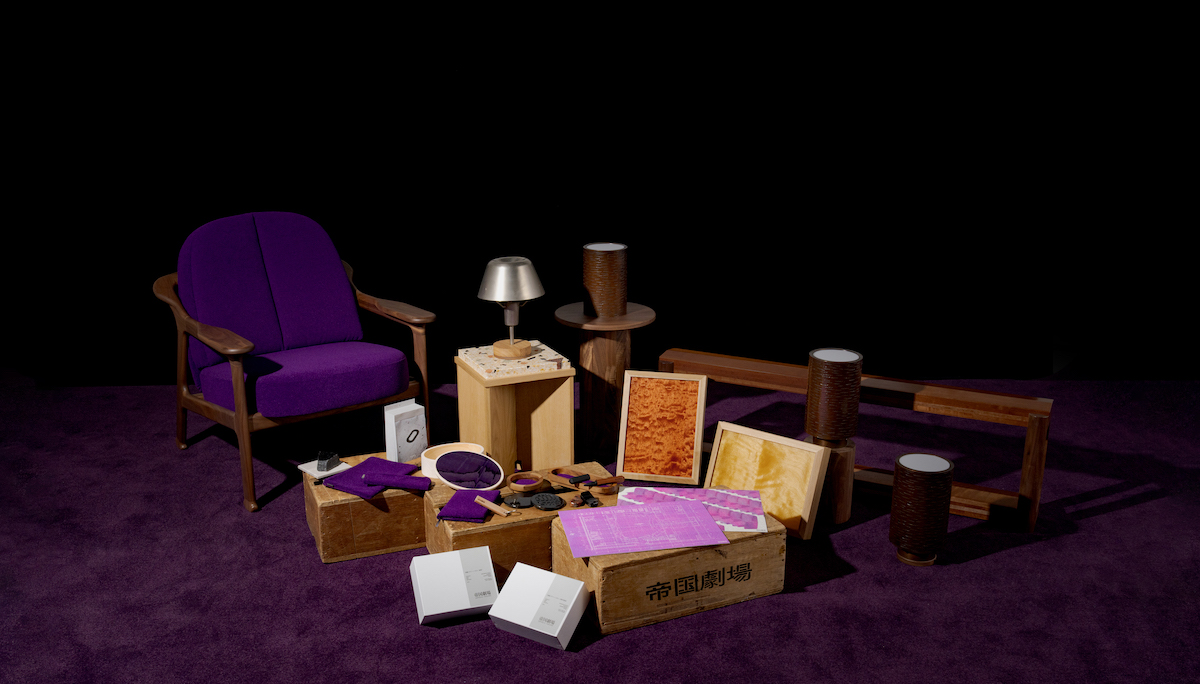
Completed in 1966, the second IMPERIAL THEATRE was a “temple of musicals” in Japan’s theatrical world, and supported theatre-goers with moving performances for more than half a century. Along with its temporary closure in late February 2025, TOHO Co., Ltd. launched the IMPERIAL THEATRE Legacy Collection, a project for turning materials from the theatre that were slated for disposal during its dismantling (including seats, lighting fixtures, railings, and pillars) into new products.
The IMPERIAL THEATRE Premium Remake represents the culmination of this IMPERIAL THEATRE Legacy Collection. It is a series consisting of 30 types of items in all that were manufactured mainly by Karimoku Furniture Inc., and was achieved through collaboration with a number of external designers. The series lineup runs from remade furniture that brings the warmth of theatre seating into the home to various accessories. The products born through this project are going to be sold at ZOZOVILLA beginning on January 17 (Sat.), 2026. In addition, plans have been finalized for holding an exhibit titled IMPERIAL THEATRE Legacy Collection - 2026 Winter at two venues: KARIMOKU RESEARCH CENTER, which is managed by Karimoku Furniture, and Hibiya Chanter, a commercial facility located in Tokyo’s Hibiya district. Those who visit the exhibition, which begins on the same day as the sales at ZOZOVILLA, will be able to experience the full scale of the project.
During its temporary closure, how could the memory and brand of the second theatre be carried on and linked to the next, third theatre? Hideaki Hatano, from the IP Strategy Office of the TOHO Theatrical Division, is the key person who started this highly conceptual project from zero and led its execution. For this article, Ryoh Hasegawa interviewed Hatano about the background of the project’s implementation, the work behind the collaboration with Karimoku Furniture and external designers, and the deep sentiment that went into the products.
* Bringing the memory of the IMPERIAL THEATRE into the future: 59 years of warmth abiding in the materials. The story of rebirth woven by the IMPERIAL THEATRE Legacy Collection and Karimoku Furniture
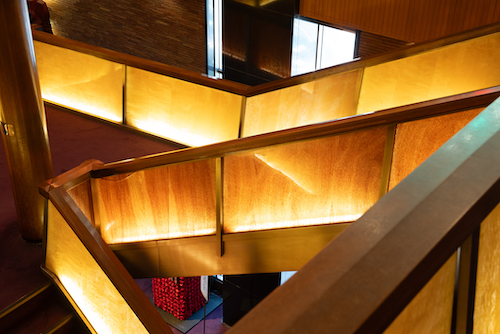
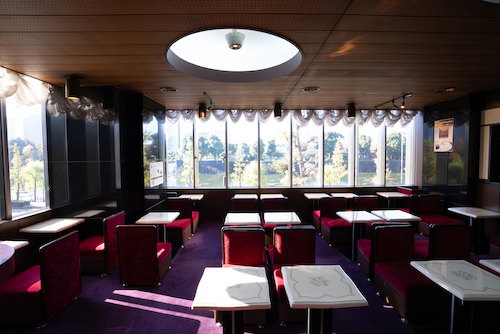
Hatano joined TOHO in 2019 and spent his first year there in sales for the IMPERIAL THEATRE. After assignments to other positions in the Theatrical Division, he joined the IP Strategy Office, which was established within the Theatrical Division three and a half years ago, and was placed in charge of new project planning. In this department, tasked with seeking new revenue schemes revolving around theatrical entertainment, Hatano undertook the Imperial Theatre’s closing project as one of his first initiatives.
Generally, when people hear the term “intellectual property” (IP) they think of intangible assets such as animated characters and stories. But at the core of this project was a novel conception of defining the tangible theatre itself as IP.
The IMPERIAL THEATRE Legacy Collection project took its start from awareness of an issue: wasn’t there some way to prevent the theatre brand from being forgotten during its closure until the completion of the third one? The team sought to preserve its presence and memory of the second theatre, which was loved by theatre-goers for 59 years, in a tangible form.
Hatano commented on this conception as follows.
“In the minds of many people, the term IP conjures up animated character contents like Pokémon and Godzilla. The important factor for our project was that we regarded the IMPERIAL THEATRE per se as IP. Built in 1966, the second theatre attracted a huge number of visitors over a period of about 59 years. In light of this history, we pondered how we could keep its brand in the minds of theatre-goers during the blank period until the opening of the third theatre. How could we showcase the theatre itself, rather than the productions on stage? The answer was a ‘remake,’ i.e., the creation of products in the upcycle context. This was the conceptual spark and point of departure for this project.” (Hatano)
At the same time as developing this idea and vision, Hatano was in contact with ZOZO, Inc., concerning the prospects for collaboration in a different project. By sheer coincidence, in the course of his communication with his counterpart at ZOZO, he learned of a project by Karimoku Furniture to upcycle seats from the Japan National Stadium upon its closure as a precedent for the remake concept. Taking a clue from this, he commenced collaborating with ZOZO on this project. Because wooden members were extensively used as building materials for the theatre, a referral from ZOZO led to talks with Karimoku Furniture, one of Japan’s leading manufacturers of wooden furniture.
At the time of the project’s take-off, there was a two-phased strategy.
“When we launched the IMPERIAL THEATRE Legacy Collection project, we first wondered what we could do with the theatre, and hit upon two orientations: selling furnishings and fittings as they were, and remaking them into new products through upcycling. We had begun preparing for the project about three and a half years ago, and decided that we could do both if we took our time. “Let’s do both” was therefore our point of departure. As for our sales strategy, we first focused on the long-time theatergoers—those with a deep personal connection to the IMPERIAL THEATRE through years of attendance. For them, we decided to deliver objects they had actually seen in the lobby and elsewhere in the theatre, as a way of showing our gratitude. We want these tokens of memories of the second theatre to be kept close at hand, serving as a link to the next theatre. This was the thinking behind the sale of these articles.” (Hatano)
First, the project team sold furnishings of the Imperial Theatre as they were to its existing fans (initiated in August 2025). Next, they took aim at broadening the legacy of the second theatre to a wider range of people and leading them to the third theatre. As a proactive strategy to this end, they plotted a path toward developing these remade products. Hatano said that they targeted an approach to new customers who were not yet fans of the second theatre, particularly through extensive use of ZOZO’s sales network.


In implementation of the project, what Hatano focused on most, and dedicated the most time to, was a careful alignment of perspectives among all concerned. The IMPERIAL THEATRE was such a special place that it was even called the “temple of musicals” among the theatre community. There were reportedly various views inside and outside Toho on the use of materials from it.
“The IMPERIAL THEATRE carries the weight of 59 years of history; It is an extremely special theatre that is even called the ‘temple of musicals’ within the industry. As this suggests, it is recognized as a theatre marked by a very strong attachment to it, not only in Toho but also among its fans. In fact, some within the company expressed apprehensions that the work should proceed with caution to avoid detracting from the historical value of the theatre. Looking back at its history, however, reveals that, while being so massive and substantial that it came to be called a temple, the theatre also had a proactive aspect of staying ahead of the times.” (Hatano)
In response to apprehensions that use of the materials was liable to be equated with destruction of the dream, Hatano dug deeply and came to grips with the history of the IMPERIAL THEATRE. Designed by Yoshiro Taniguchi, the second theatre was itself a proactive theatre ―one built with an immense budget and palatial design specifications for the Japan of that time.
Based on this historical background, Hatano took the time to convey to all concerned the context of achieving both an innovative character to take up new challenges and a weightiness treasuring the memories of theatre-goers. He said that the collaborating creators and concerned Toho personnel deepened their understanding of the Imperial Theatre by viewing performances and reading commentary on its history there.
“In line with this context, we promoted the project while spending about a year and a half to make sure all understood that, while taking up unprecedented new challenges, at the core of the work were deep feelings for the IMPERIAL THEATRE among theatre-goers and our employees.” (Hatano)
The project team also paid close attention in the work of extracting materials and discerning pieces of art. For example, in the dismantling of stone materials from pillars, they invited a specialist from Yabashi Marble Co., Ltd. who had been in charge of the pillar construction at the IMPERIAL THEATRE 59 years ago. This specialist shared the construction methods of those times as the work proceeded. Everyone conscientiously tackled what were first-time tasks for them by relying on documents from the past and the know-how of professionals.
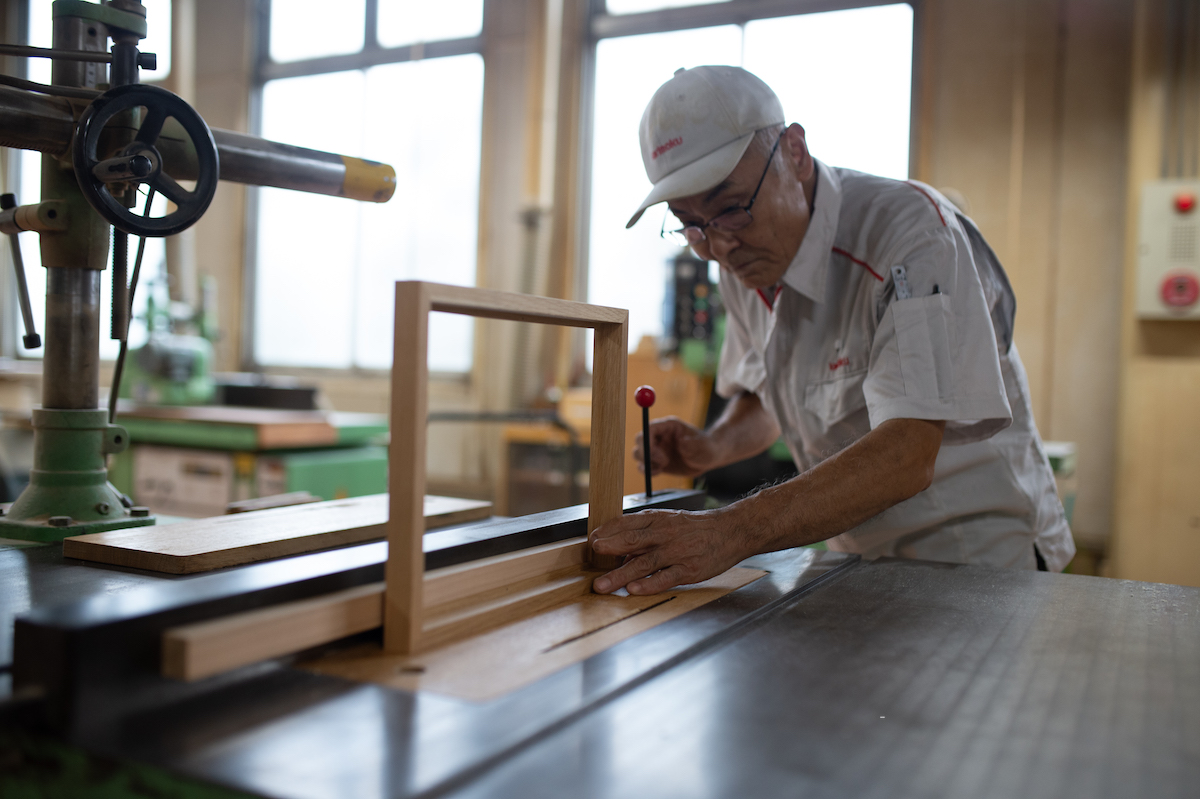
Six groups of external designers joined this remake project, brought together by SAKUMAESHIMA—an architectural design firm that also engages in product design—at the invitation of Karimoku Furniture. Hatano gained new insights through this collaboration with product designers and furniture manufacturing professionals, which was different from his usual work with theatre creators like directors and playwrights.
In the phase of product development, decisions on designers were made about a year and a half before the closure of the IMPERIAL THEATRE, toward the end of 2023. Because the extraction of building materials began in March 2025, after the closure, the intervening period was used for making preparations. The designers were asked to go to the theatre before its closure and inspect the wood of the railings and stone of the pillars as materials that could possibly be used.
However, determinations on which materials could be used and how many of each type could not be made until the dismantling work began. For this reason, coordination among the designers was said to be particularly difficult.
Hatano held general meetings once every two or three months for a sharing of designer’s ideas and information on the situation as regards usable materials, one by one. Furthermore, he arranged opportunities for all of the designers to communicate with each other and heighten their morale through programs including a tour of Karimoku Furniture's factory in Aichi.
As a result, items were split up in a manner that would allow the designers to each exercise their individuality in their fields of special competence, without a scramble for materials among them. Under the direction of the TOHO Theatrical Division, the project eventually gave birth to an assortment of 30 diverse products. Hatano revealed that he had had a vague idea of this product lineup right from the start of the project.
“I made a list of the building materials that could be used, and identified eight or nine types. I wanted to make as many items as were conceivable and possible within this scope. This desire was tied to the policy of doing all we could do, including selling furnishings from the Imperial Theatre Legacy Collection and manufacturing remade products. Seeing that we were receiving cooperation from Karimoku Furniture, I definitely wanted the assortment to encompass furniture (chairs and tables). Similarly, because the lobby light fixtures were usable, I naturally also had a hazy notion of creating some sort of ‘re-products out of them.” (Hatano)
The manufacturing request was made to Karimoku Furniture, a wooden furniture manufacturer, precisely because of Hatano’s strong desire to produce chairs and tables using wooden building materials from the Imperial Theatre. Each of the designers developed a profound understanding of the story behind the materials (railing wood, lighting, and pillar stone), and made repeated trial and error with a view to passing on their memory.
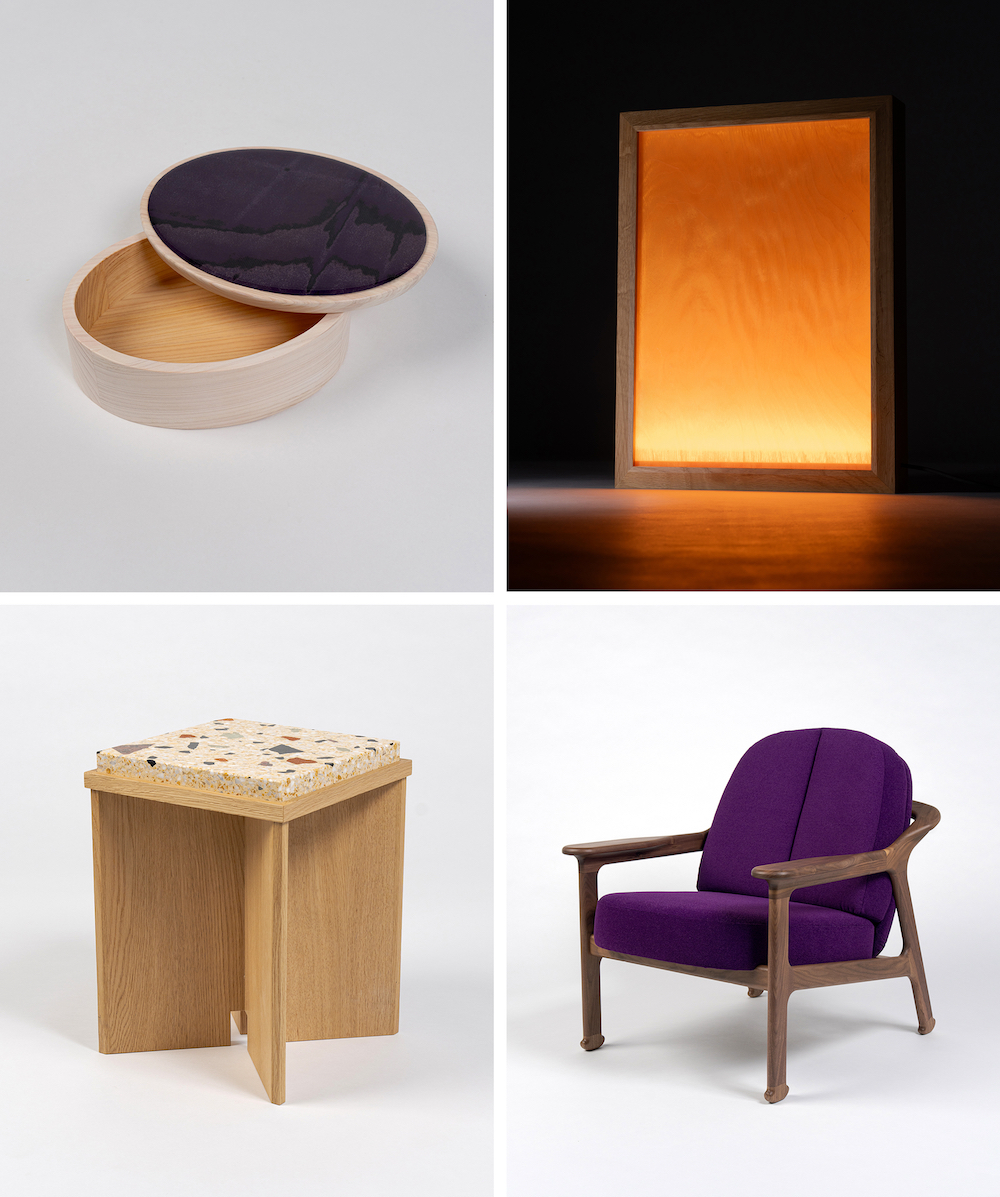
In the middle of April 2025, upon completion of the material extraction, the designers set about production with the actual materials in hand, and completed all samples by the end of October, about half a year later. The lineup of all 30 items came together under one roof in mid-November, when they were photographed as products in the factory studio of Karimoku Furniture.
At this time, Hatano said that he shared a feeling of profound fulfillment with the Karimoku Furniture team, exclaiming “we have finally come this far!” The finished products were also shown to concerned Toho colleagues who had displayed a cautious attitude toward the project.
“We also gave the in-house staff a look at the finished products. We arranged the tables and other articles in an exhibition-like row within a largish conference room in the company. Many of our colleagues told us they were really excited to see the products. This was still before we started sales, but their favorable response made me feel happy that we had undertaken the project. Even those who initially expressed wary views gave us the highest praise after seeing the finished products. As it turned out, the sentiment we put into these products was solidly conveyed, and I saw this as proof that we had achieved high-quality craftsmanship.” (Hatano)
To Hatano, the change in reaction to “excitement” after seeing the finished products was firm evidence that the project had succeeded. It could also be termed proof that the project had sublimated the materials into beautiful products adapted to contemporary living without detracting from their historical weight.
The ultimate objective of the IMPERIAL THEATRE Legacy Collection lies in linkage of memories and brand to the succeeding, third theatre. While relating his thanks to all of the people who had cherished the theatre over the preceding 59 years, Hatano again emphasized the sentiment that had gone into the remade products.
“As I mentioned when we launched sales of furnishings from the Imperial Theatre, on behalf of both TOHO and the theatre, I must say I am filled with gratitude to everyone who had cherished and visited the theatre over the period of 59 years. Furthermore, we carried out this project with the earnest hope that everyone will carry these connections forward to the next IMPERIAL THEATRE, opening in a few years. It is, of course, best if people can experience productions first-hand in the theatre. It is nevertheless our fervent wish that they will continue to retain the memory of the second theatre and feel the weight of the materials themselves through these products crafted with building materials and furnishings from the theatre and kept close at hand.” (Hatano)
The remade items are all designed to become fixtures of everyday life and can be used for a long time even after the birth of the third IMPERIAL THEATRE.
People will have the opportunity to feel the warmth of the materials and the history of the IMPERIAL THEATRE directly at the Imperial Theatre Legacy Collection Exhibition to be held at two locations: KARIMOKU RESEARCH CENTER and Hibiya Chanter. Hatano clearly defined mutually different roles for these venues.
“The exhibition will be held at two venues. One is a special space set up within Hibiya Chanter, which is close to the IMPERIAL THEATRE. It is a place where people can drop in and see the exhibition after going to the theatre. The other is an exhibition at KARIMOKU RESEARCH CENTER. Located in Nishiazabu, Tokyo, the center is managed by Karimoku Furniture. Here, visitors will be allowed to actually touch and handle the 30 articles in the lineup and so experience them first-hand. This is a major point of difference from the venue at Hibuya Chanter. I urge people to experience the products in this way at the center. (Hatano)
This project made full use of building materials from the Imperial Theatre and succeeded in remaking almost all of them into every conceivable product. For Hatano, and for the entire Imperial Theatre Legacy Collection, it is the culmination of a vision.
As we look toward the rebirth of the third IMPERIAL THEATRE, the story and warmth of the second theatre will seamlessly blend into everyday life through Karimoku Furniture’s craftsmanship and the creativity of external designers. This story of rebirth will surely serve as a new model for the inheritance of Japan’s cultural legacy.
* Outline of the exhibition
・Venue
- THE ARCHIVE, 1F, KAROMOKU RESEARCH CENTER ( 2-24-2 Nishi Azabu, Minato Ward, Tokyo 106-0031, Japan)
- Special venue, 3F, Hibiya Chanter (1-2-2 Yurakucho, Chiyoda Ward, Tokyo 100-0006, Japan)
・ Run
- KARIMOKU RESEARCH CENTER: January 17 (Sat) –February 14 (Sat), 2026
- Special venue, 3F, Hibiya Chanter: January 17 (Sat) –March 1 (Sun), 2026
・Sales:
Beginning on January 17 (Sat), 2026, at ZOZOVILLA
https://zozo.jp/event/teigeki-karimoku/
・Participating designers
- HIGHTIDE
- Sae Honda
- Yuma Kano
- Yoh Komiyama
- SAKUMAESHIMA
- Hisakazu Shimizu (S&O DESIGN Inc.)
Stone specialist: Yabashi Marble
