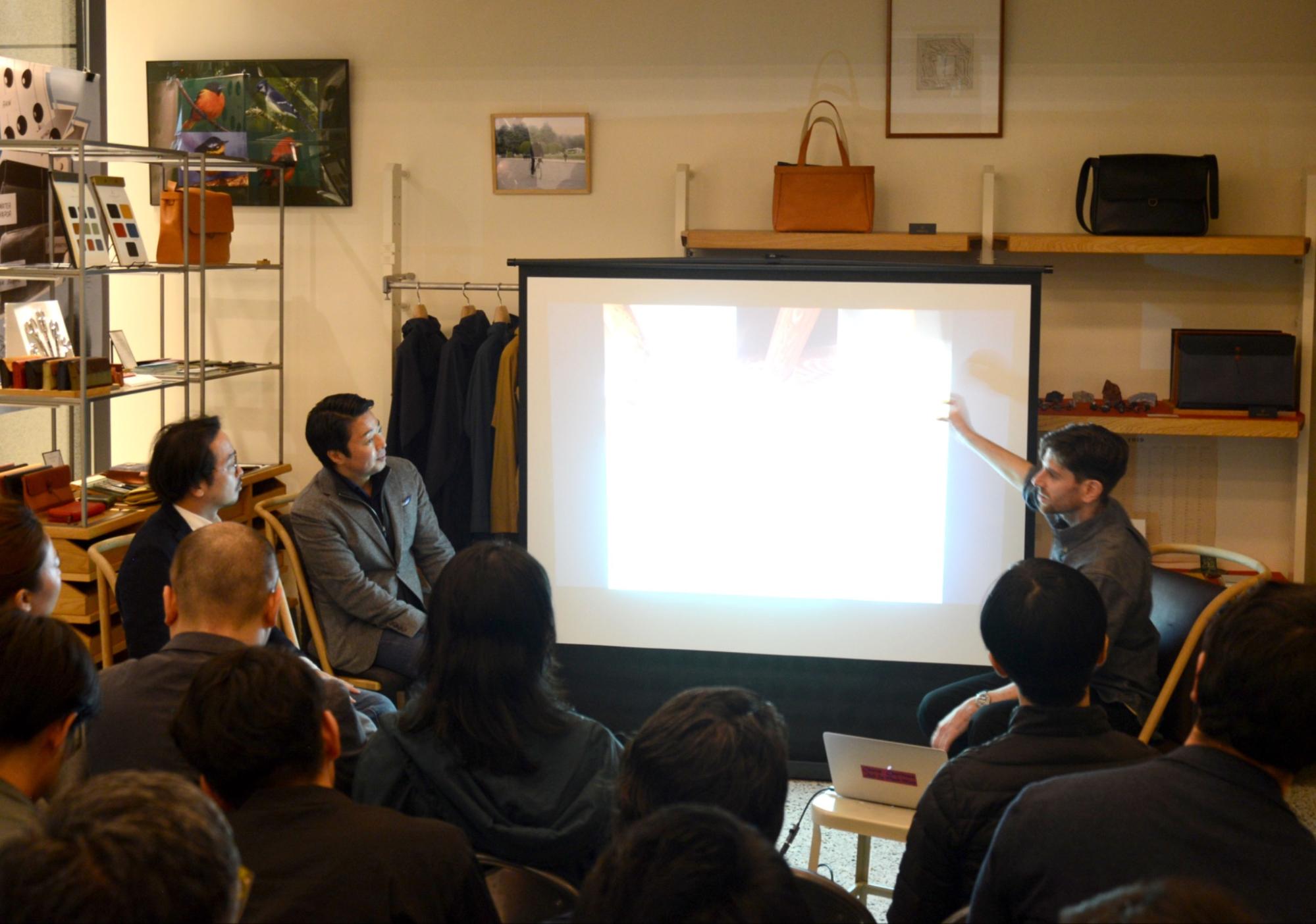
Scenes from the talk event in the initial collaboration between Karimoku Furniture and Postalco Design Studio
In October 2024, Karimoku Furniture Inc. launched a new project titled “KARIMOKU RESEARCH.” The “Survey” at the core of the project takes up four themes a year, and is conducted in partnership with creators, designers, artists, companies, and other parties, both inside and outside Japan, on each theme. The insights obtained from the “Survey” provide the basis for the display and development of new solutions that are not confined to furniture.
The theme of the third “Survey” is “TIMELESS CHANGE.” The “Survey” delved into the question of what lives with time and is left by time. Postalco Design Studio, which was founded in Brooklyn, New York and is now based in Tokyo, participated as a researcher. It continues to make products with a focus on everyday living, and applies its unique perspective in designing everything from apparel and furniture to space.
Today, when disposable items have become the norm, Postalco is pursuing designs that are premised on long-term use. A particularity about rigorous Japanese-style production born of dialogue with Japanese artisans forms a solid foundation for its designs. The fusion of its philosophy and Karimoku Furniture’s technology created STAKKO stowage furniture. We conducted an interview with Postalco’s Mike and Yuri about the efforts that culminated in the birth of STAKKO.
Besides tracing the encounter between Postalco and Karimoku, Part 1 discloses some engrossing and hitherto unknown stories about Mogul Ski Chair, the first product of their collaboration. It also zeroes in on the essence of ever-evolving Japanese craftsmanship found at the sites of production by Karimoku Furniture.
Postalco’s history as a design studio began in Brooklyn, New York in 2000.
Postalco launched its brand with the objective of making products that would long be loved by their owners, and set about producing a wide range of goods including bags, apparel, and even furniture.
Mike and Yuri said that they became acquainted with Karimoku Furniture a few years ago, through a mutual friend. At this time, Hiroshi Kato (Vice-President of Karimoku Furniture Inc.) was already using Postalco products, and said he felt a deep empathy with Mike’s outlook on design and product design.
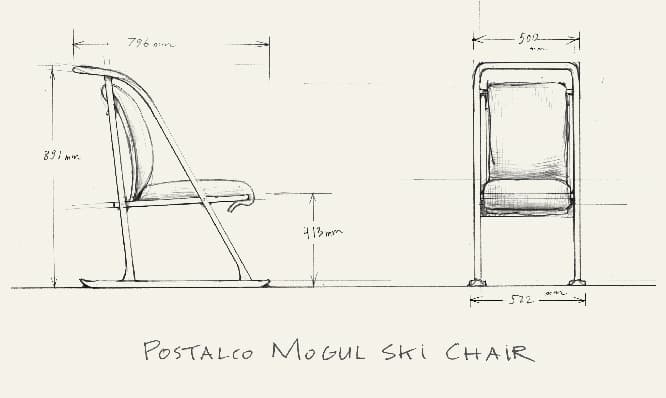
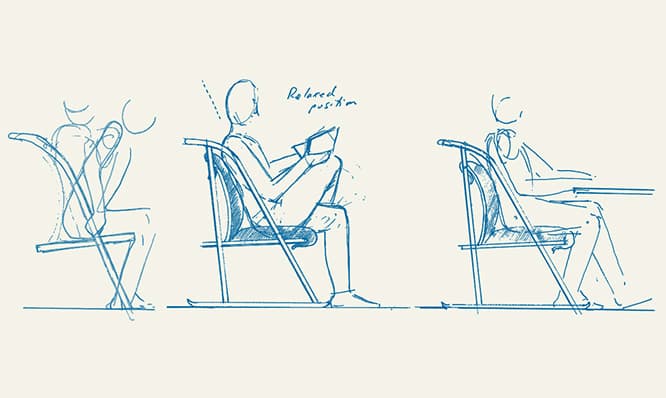
This encounter led to specific collaboration out of a desire to create some furniture together. The first product of this collaboration was a chair that was named the “Mogul Ski Chair.”


Why did the two decide to make a chair? The initial idea came from noticing an everyday occurrence that, while trivial, could not be overlooked.
“To tell the truth, for a long time, I was bothered by the screeching noise from the friction that occurred every time I pulled or pushed a wooden chair over the floor at my house. Mike came up with the idea of a structure adding a part like a ski to each leg of the chair. Thanks to this unique structure, it became possible to move chairs around smoothly and silently. I love using this kind of chair at the Postalco office every day.” (Yuri, Postalco)
“This Mogul Ski Chair looks simple at first glance, but has an exceedingly complex structure requiring a high level of woodworking know-how. Nevertheless, we managed to make a high-quality product by applying Karimoku Furniture’s outstanding technology and precision. This collaboration spurred the sure advancement of Postalco’s production.” (Mike, Postalco)
In addition to this chair, the two companies also developed other articles such as the Handle Box, a storage box with a wooden handle for holding magazines and documents. This initial period of collaboration nurtured a mutual trust between the two and an affinity that grew out of fastidiousness extending to details. The STAKKO introduced here heralded the birth of the first product that was designed by Postalco and sold by Karimoku Furniture.
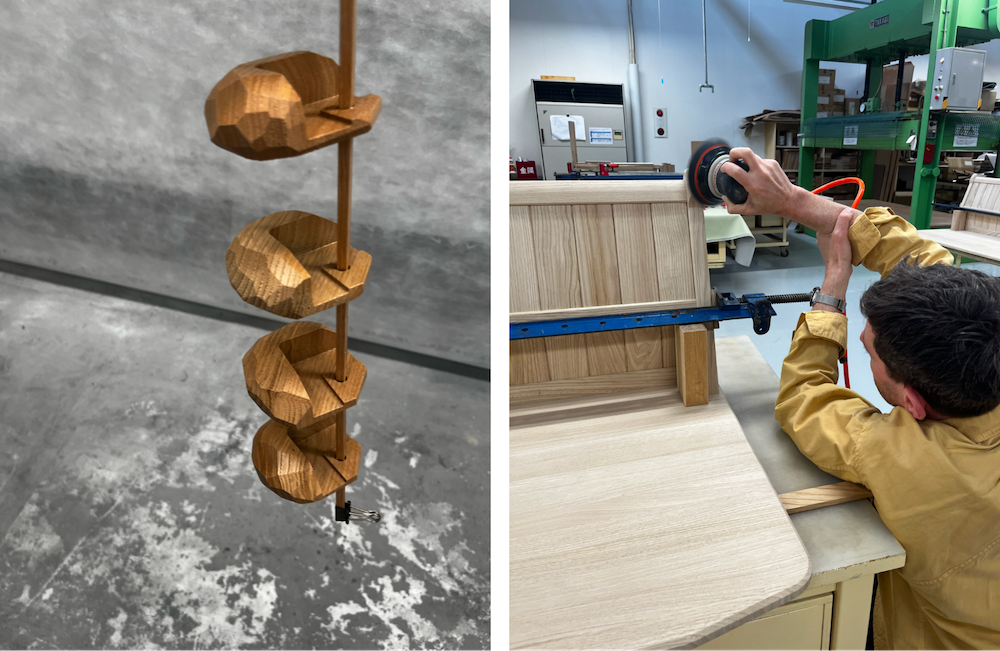
In this installment of the KARIMOKU RESEARCH “Survey,” there were no particular research activities, but Mike had visited Karimoku Furniture’s head office and factory in Aichi Prefecture two times before, and again visited the factory for box-type products in connection with the STAKKO production this time. One of the things that deeply moved him from his experience of these factory visits was the painting process in the factory.
Typically, overspray (the adherence of sprayed paint to places other than the intended surface) occurs during painting. Karimoku Furniture’s box factory, which is in charge of manufacturing STAKKO, has taken an ingenious measure to counter overspray in the painting process. Water constantly flows down the wall behind the painting line and is recirculated. It catches the drops of paint that missed the intended surface. Moreover, the water contains special bacteria that break down and treat the particles of paint particles to allow its reuse.
Mike was amazed at this mechanism for alleviating environmental impact.
“I wondered what on earth it was. I had never seen anything like it before. There was nothing written about it even on the company’s website. I was told that they had in fact been doing this for about 30 years. I had never even heard of this technology.” (Mike, Postalco)
This painting technology is not a mere matter of higher efficiency; it is a manifestation of Karimoku Furniture’s unswerving commitment to not releasing hazardous substances outside the factory and, above all, to show its concern for the health of the people working there. In referring to the artisan-like techniques at Karimoku Furniture, the interviewees also mentioned how the meaning of Japanese-style production, which Postalco treasures, was brought home to them all over again. It is not a one-way process of simply painting a picture and handing it over to the factory.
“As might be expected, products rapidly become better when you do the manufacturing while talking with each other. For example, they last longer, are of even higher quality, and have grains that are prettier and look more natural. In factories that control things down to the smallest details, the products themselves reach a completely different level and evolve further.” (Mike, Postalco)
Postalco, too, is particular about having all of its products made in Japan. It makes products while engaging in joint development with Japanese artisans. It was precisely this stance of joint development that became the unshakeable point held in common and supporting the collaboration between Postalco and Karimoku Furniture.
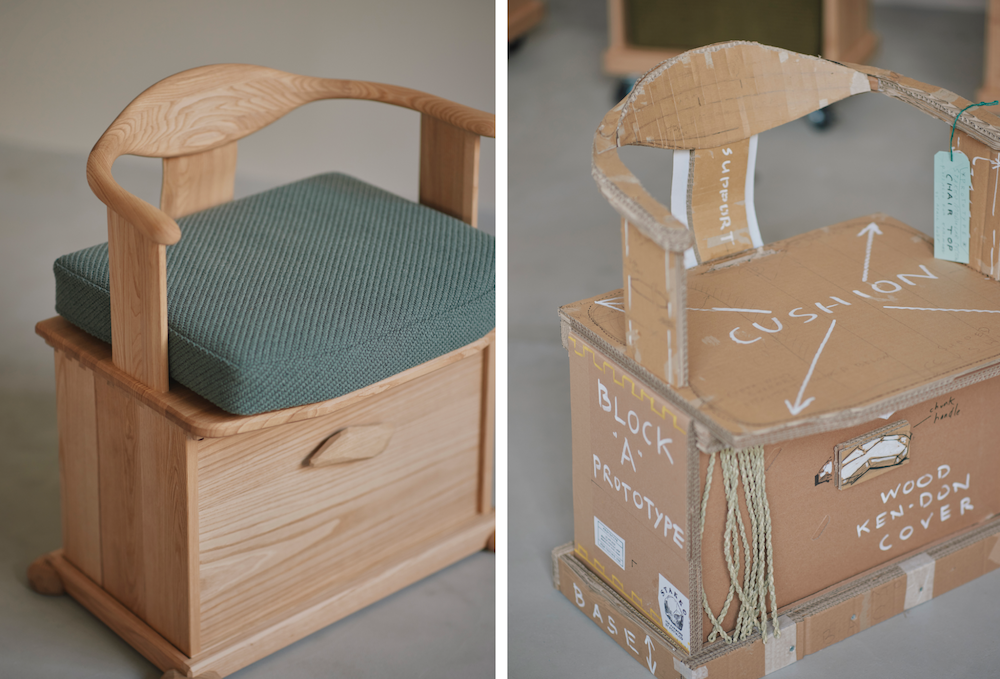
Postalco’s production emphasizes a trial-and-error process using a physical prototype. The technology available at present enables real rendering, but both Mike and Yuka think rendering has pitfalls.
“Digital rendering may look perfect at first glance, but you are liable to miss some key elements grasped with the senses, such as the “feel” when actually taken in hand, meaning the weight and texture. We always place a lot of importance on whether or not the product is physically comfortable.” (Yuri, Postalco)
“Once the design has been determined, we request Karimoku Furniture to actually manufacture the product. In some cases, we then discover problems, such as the chair being uncomfortable for sitting at a certain angle, being larger than we had thought, or not being pleasant to the touch. For the swift resolution of such problems, it is extremely important to make physical prototypes using paper or other materials.” (Mike, Postalco)
In the final analysis, we too are physical living beings, and it is vital for products that can be touched to have a physical affinity with us. For this reason, the interviewees said that they make prototypes with paper or cardboard at an early stage for quick detection of problems by actually touching and handling them. By sharing the physical prototypes with artisans, they can have deeper, more specialized discussions that take up the quality of joints, for example, and facilitate the birth of better products as a result, they added. This process played an extremely important role in the development of STAKKO as well.
Part 2 will take up the question of why Postalco set their sights on stowage furniture this time, and get to the bottom of a contemporary issue behind the reason: the relationship between you and the things you have.
At the same time, it will dig deeper into the story of the development of the storage furniture STAKKO, the insistence on pure chestnut wood, the know-how imbuing the dovetailing technique, and the whimsy and warmth appearing in options such as corded curtains and rugs.